AI Job Search in 2026: What AI Actually Changes at Each Stage
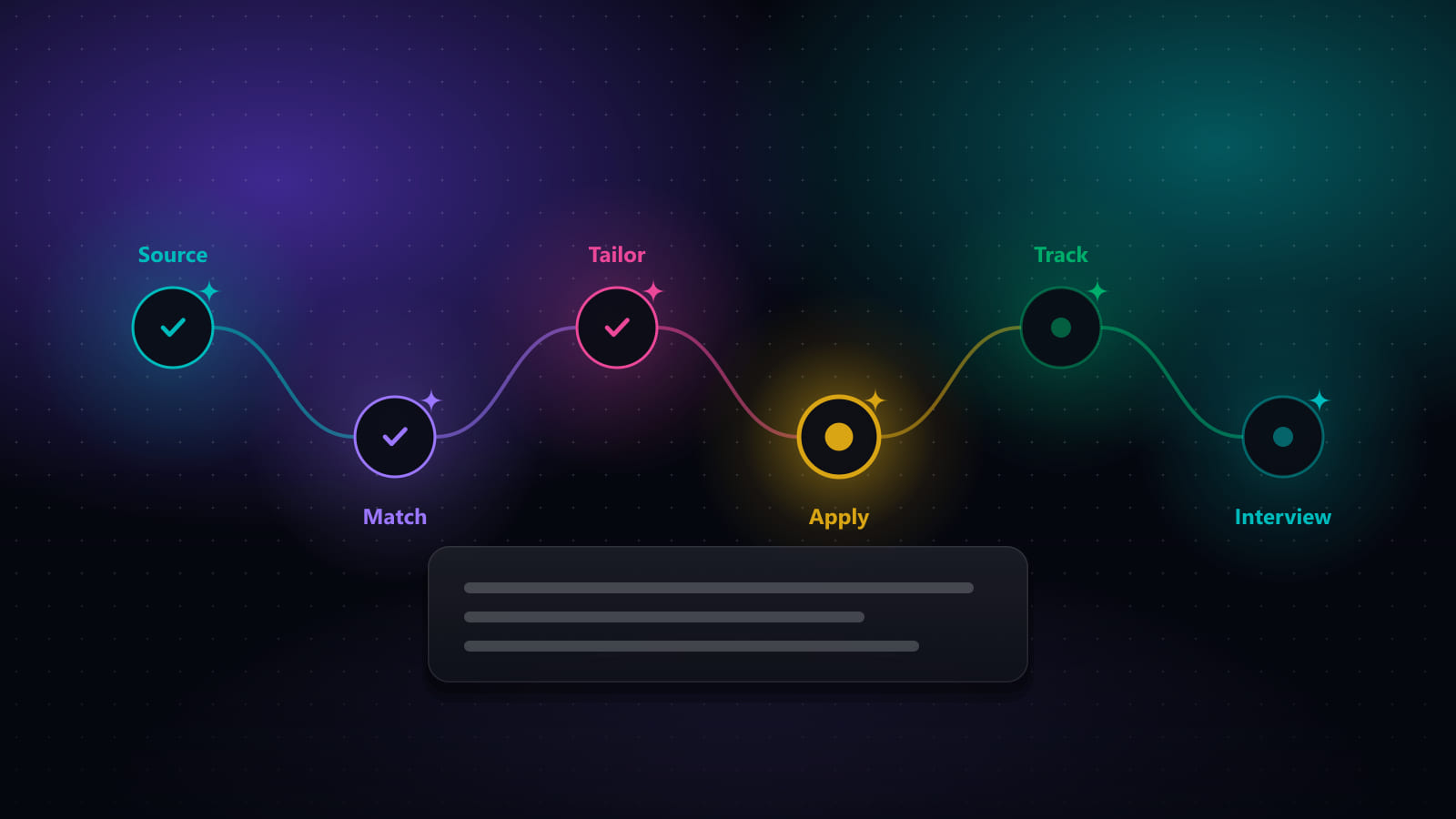
The phrase “AI job search” suggests one thing happening. In practice a job search has six distinct stages, and AI has a completely different effect on each. Four of them compress dramatically. Two barely move at all.
Knowing which is which is most of the value, because it tells you where to spend money and where spending money changes nothing.
Key takeaways
- A job search has six stages: define, source, match, tailor, apply, and prepare. AI compresses sourcing, matching, tailoring and applying — the four that are mostly administrative.
- It does not meaningfully compress defining your target or preparing for interviews, because the work in those stages is the thinking, not the output.
- Automation multiplies whatever targeting you already have. A sharp target gets much faster; a vague one produces rejections faster.
- The highest-value early use of AI is diagnostic — finding out why applications are not converting — not raising volume.
- Every automated stage needs a checkpoint where a human can see what is about to be sent.
Stage 1 — Define what you are looking for
How much AI helps: barely at all.
This stage is deciding role, level, industry, location constraints, compensation floor, and what you will not accept. It is a small amount of writing and a large amount of deciding, and no tool can do the deciding part for you.
It is also the stage that determines the return on every later stage. A search profile defined as “software engineer, remote” will surface thousands of roles of which most are wrong, and every downstream automation will then faithfully process that noise. A profile defined as “backend engineer, Python or Go, remote within EU time zones, 5+ years, not agency” produces a tenth as many results and a far higher share worth applying to.
The only genuinely useful AI application here is as a sounding board: describing your background and asking what role families it maps onto can surface options you had not considered. The decision stays yours.
Stage 2 — Source the postings
How much AI helps: very substantially.
This is the most mechanical stage in the entire process and the one automation transforms most completely. Checking a dozen job boards daily, deduplicating listings that appear on several of them, and noticing which are newly posted is work with no judgement in it.
What good sourcing automation provides: coverage across many boards rather than the two or three you would check by hand; deduplication, so one role reposted on four boards is one entry; recency filtering, because application timing measurably affects response rates; and a scheduled run, so the search happens whether or not you remember.
The realistic gain is large — several hours a week, reclaimed permanently.
Stage 3 — Match and filter
How much AI helps: substantially, with a caveat.
Matching scores how well a posting fits your background so you can spend attention on the top of the list rather than reading everything. This is genuine AI work — it requires understanding that “PostgreSQL” and “Postgres” are the same thing and that a “Platform Engineer” posting may describe the job you currently hold under a different title.
The caveat is that a match score is not an objective measurement. It is the output of choices a vendor made about weighting, synonyms and how to penalise missing skills, which is why two tools score the same resume against the same job differently. Treat a score as a sorting aid, never as a verdict — how match scores are actually calculated goes into the mechanics.
Stage 4 — Tailor your documents
How much AI helps: substantially, with supervision.
Tailoring a CV per application is known to improve outcomes and is also the single most tedious task in the search, which is exactly why most people stop doing it around application twenty. Automating it is the difference between tailoring everything and tailoring nothing.
What AI does well here: reordering so the relevant experience appears first, adopting the posting’s vocabulary where it genuinely matches yours, and cutting content that is irrelevant to this role.
What it does badly, consistently: inventing plausible-sounding metrics, overstating seniority, and producing cover letters that are enthusiastic in a way that could apply to any employer. This is the one stage where reviewing the output is not optional — what to check in an AI-tailored CV covers the review.
Stage 5 — Apply
How much AI helps: very substantially.
Application forms re-ask what your CV already answered, across multi-page wizards, differently on every applicant tracking system. There is no judgement in retyping your work history for the fortieth time.
Automation here ranges from autofill, which fills fields and leaves you to submit, through to auto-apply, which completes and submits the whole thing. The difference matters more than the marketing usually admits — see how submission automation actually works.
The requirement at this stage is a checkpoint: some moment where what is about to be sent under your name is visible, and stoppable, before it goes.
Stage 6 — Prepare and interview
How much AI helps: moderately, but not by saving time.
AI is genuinely useful for generating likely questions from a job description, rehearsing answers, and identifying gaps in how you explain your own experience. But the benefit comes from doing the practice, so there is no time to save — an AI-generated answer you have not rehearsed is worth nothing in the room.
This stage is where a search is actually won or lost, and it is the stage automation cannot compress. That is worth remembering when the earlier stages start giving time back: the right thing to do with the reclaimed hours is spend them here.
Putting it together
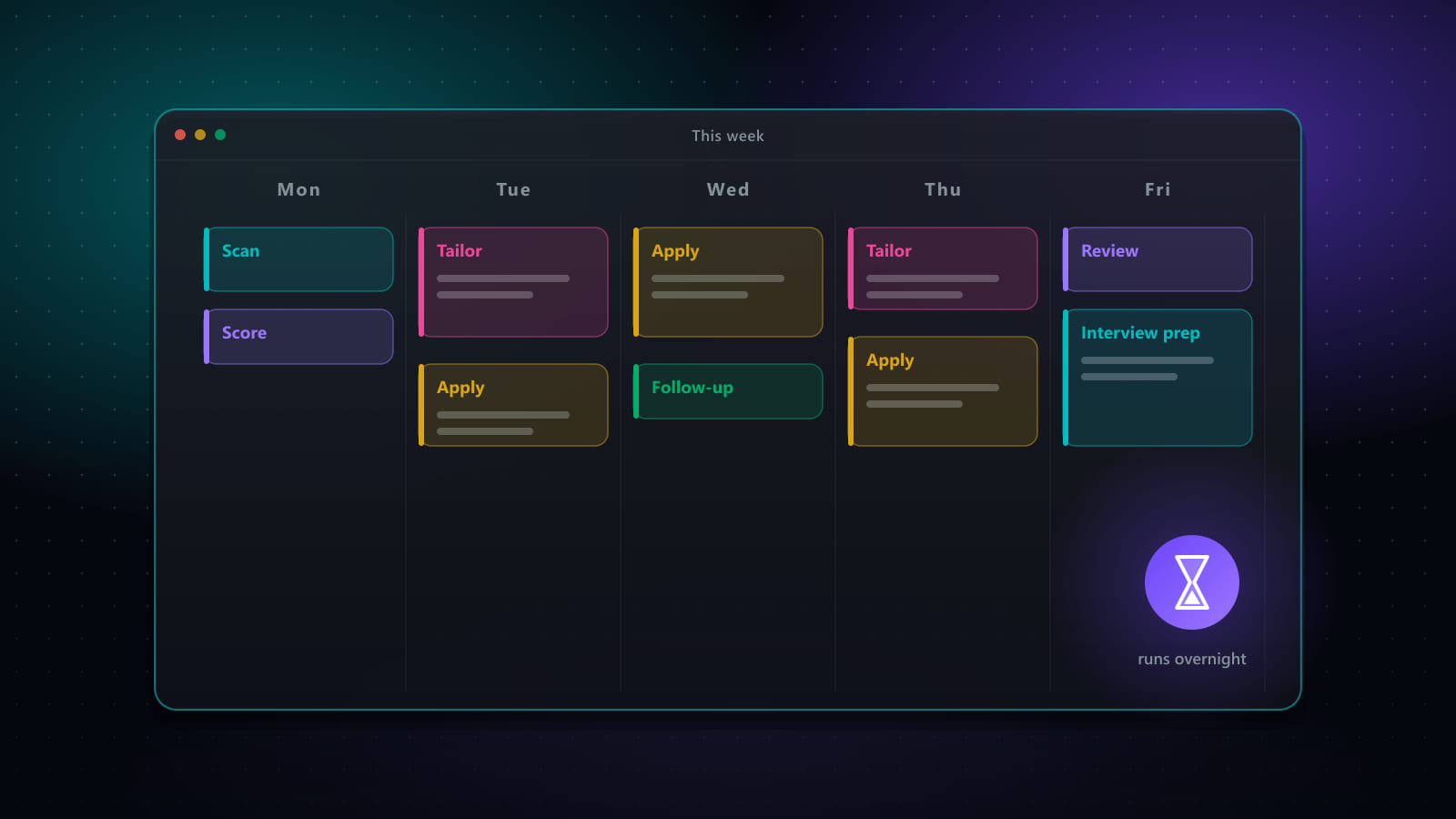
A realistic weekly rhythm once the automatable stages are automated: sourcing and matching run on a schedule in the background; you spend a short block reviewing the shortlist and rejecting bad matches; tailored documents are generated for what survives; applications go out with a review checkpoint; and the time that used to go into all of that goes into interview preparation instead.
Job search automation: a weekly operating system sets out that cadence in detail.
Frequently asked questions
What is an AI job search?
An AI job search uses software to compress the repetitive stages of looking for work: finding postings across multiple boards, scoring how well each one matches your background, rewriting your CV and cover letter for a specific role, and filling in application forms. It does not change the stages that depend on judgement — deciding what you want, preparing for interviews, and negotiating — so it is better understood as removing administrative load than as replacing the search.
Does AI actually help you get a job faster?
It reliably helps with throughput: more relevant roles found per hour, and far less time per application. Whether that turns into an offer faster depends on whether your targeting was good to begin with. Automation multiplies your existing targeting, so a well-defined search gets substantially faster while a vague one mostly produces rejections at a higher rate. The single highest-leverage use of AI in a job search is diagnosis — finding out why applications are not converting — not volume.
Which stages of a job search should not be automated?
Three. Deciding what role you are targeting, because automation applied to an unclear target just scales the confusion. Interview preparation, because the value comes from the practice itself, not from the output. And anything that makes a factual claim about you — an automated system that writes that you have a qualification you lack has produced a misrepresentation in your name, regardless of intent.
Is it obvious to recruiters when AI wrote an application?
It is obvious when AI writes generically — unearned superlatives, no concrete numbers, and enthusiasm about the company that would apply to any company. It is not obvious when AI is used to reorder and sharpen material you actually supplied. The practical test before sending: does every claim in the document trace back to something real in your history, and could you discuss any sentence in it for two minutes in an interview?
Ready to automate your job search?
Best JobFinder combines job discovery, AI skill matching, resume tailoring, and configurable auto-submit in one platform — with a 7-day free trial.
Try Best JobFinder free →