What Is an AI Job Search Agent? The Five Levels of Autonomy
“AI agent” has become the default label for every job search product, and it now describes tools that differ by an order of magnitude in what they actually do. One fills a form while you watch. Another runs overnight and submits forty applications. Both are marketed with the same word.
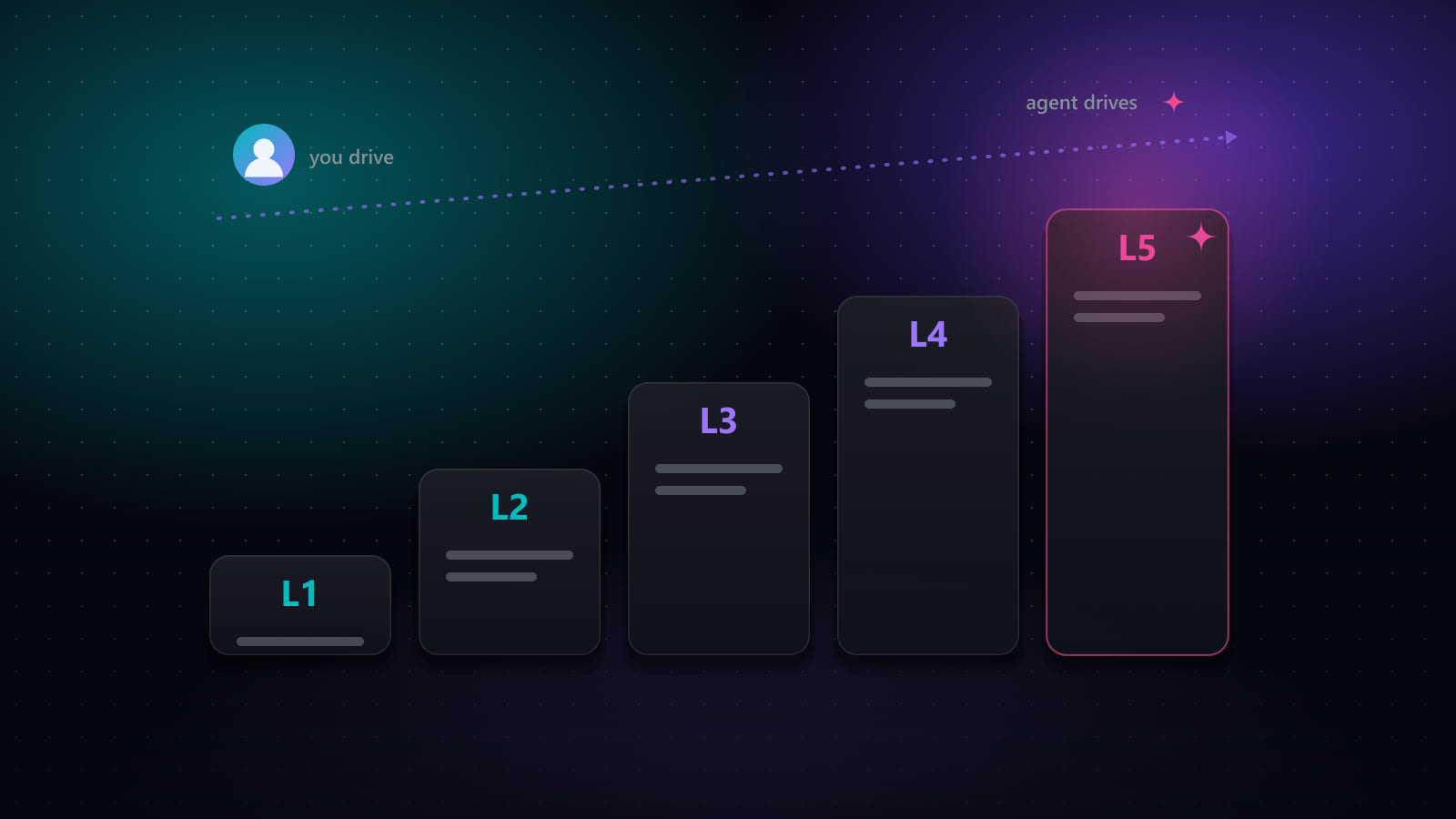
The following five levels are a way to cut through that. They describe how many consecutive steps a tool takes without you, which is the property that actually determines how much time it saves and how much supervision it needs.
Key takeaways
- Autonomy is a spectrum, not a binary. The useful measure is how many consecutive steps a tool takes before it needs you again.
- Level 1–2 tools (suggestion, assisted entry) keep you in the loop on every application. Level 4–5 move your involvement to configuration time.
- Marketing language does not track the levels — products at level 2 and level 4 both describe themselves as agents.
- Higher autonomy is not better by default. It is a trade of supervision for throughput, and it is only a good trade once targeting is sharp.
- Any tool at level 3 or above should offer a relevance gate, a rate limit, and a visible record of what it sent.
Level 1 — Suggestion
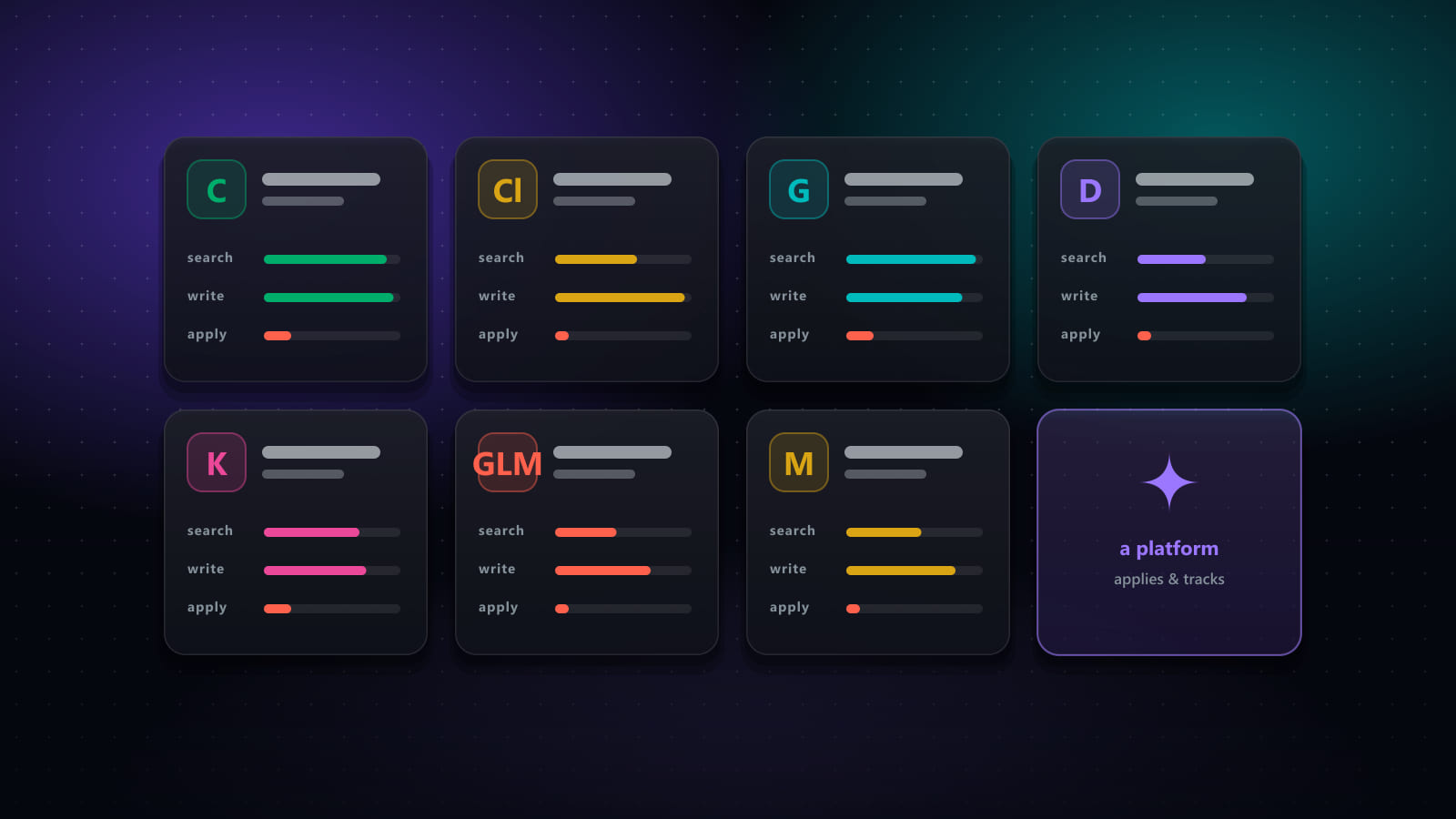
The tool produces text or analysis; you do everything else. A general-purpose chatbot asked to improve a bullet point sits here, as do resume scanners that report what is missing.
You are involved: at every step. Realistic saving: minutes per application, on writing only. Supervision needed: total, but the cost of a mistake is near zero because nothing is sent.
Level 2 — Assisted entry
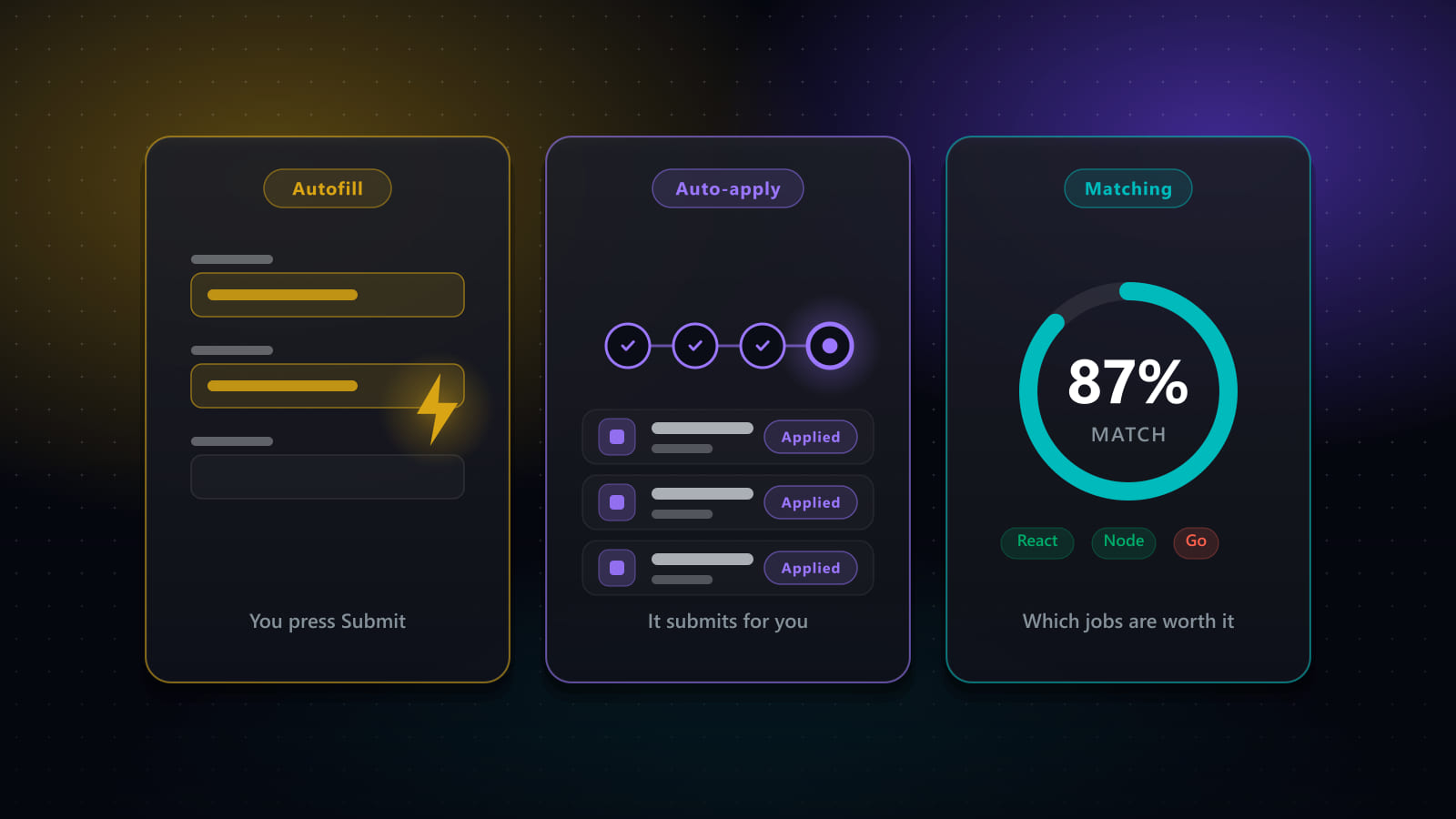
The tool acts on a page you have opened — filling form fields from a stored profile, attaching a saved CV — and then stops. You review and submit.
This is where most browser-extension products sit, including several that use agent language prominently. It is genuinely useful: form filling is the most repetitive part of applying. But it does not scale past your own attention, because every application still needs you present.
Realistic saving: the large majority of typing time. Supervision: inherent — you are there anyway.
Level 3 — Supervised sequence
The tool completes a multi-step task — open posting, fill a multi-page wizard, attach a tailored CV, stop at the final screen — and hands back for the submit decision.
This is the first level where the tool holds context across steps, and the first where things can go wrong invisibly: a question answered from a stored answer that does not fit this employer, a wrong file attached, a required field skipped. A level 3 tool needs to show you what it did, not just that it finished.
Realistic saving: most of the per-application time, while keeping a final human decision. Supervision: one checkpoint per application.
Level 4 — Bounded autonomy
The tool runs a batch unattended within limits you set — a maximum number of applications, a minimum match score, specific boards — and submits within those limits. Your involvement moves from per application to per run.
This is where the meaningful time saving lives, and also where the quality of your configuration starts to matter more than the quality of the tool. The relevance gate is doing the work your judgement used to do. If it is set loosely, the tool will faithfully apply to roles you would have rejected on sight.
A level 4 tool should let you pause a run in flight, see each application before it goes if you want to, and stop everything at once. Our own product sits here by design: auto-submit is configurable rather than always-on, and a run can be paused, edited mid-flight, or stopped.
Realistic saving: hours per week. Supervision: per run, plus reviewing the audit trail.
Level 5 — Continuous autonomy
The tool runs on a schedule with no per-run approval: sourcing, scoring, tailoring, applying and following up, indefinitely, from criteria you set once.
Bulk submitters and server-side apply services operate here. The trade-off is real and worth naming plainly: you gain volume and lose sight of individual applications. Because nothing is reviewing fit per application, output quality is entirely determined by the criteria, and criteria drift out of date as your search evolves.
The specific failure mode to watch for is applying to the same company repeatedly, or to roles well outside your range, without noticing for weeks.
Realistic saving: maximum. Supervision: periodic review of what went out — which is exactly the step most likely to be skipped.
How to tell which level a product is
Vendor marketing will not tell you, so test with these four questions:
- Does it find jobs, or only act on jobs I open? Only acting on open pages caps it at level 2.
- Does it press Submit? If every application needs my click, it is level 2–3 regardless of the word “agent”.
- Can it run while I am not at the computer? If yes, it is level 4 or 5, and the relevance gate now matters more than any other setting.
- Can I see what it sent afterwards? If there is no per-application record, you cannot audit it, and at level 4–5 that is a genuine problem rather than a missing nicety.
Which level should you actually use
Higher is not better. The right level depends on how well-defined your search is:
- Target still unclear — stay at level 1–2. Automation applied to an unclear target scales the confusion, and you will learn more from applying manually to twenty roles than from automating two hundred.
- Target clear, time scarce — level 3–4 is the sweet spot, and for most people level 4 with a strict match threshold is the best available trade.
- Target clear, volume genuinely the constraint — level 5 is defensible, provided you commit to reviewing the audit trail weekly rather than setting it and forgetting it.
On these figures: pricing and plan limits were last checked against each vendor’s own published pages on September 16, 2026. Plans change often and several vendors run regional or promotional pricing, so confirm current terms on the vendor’s site before buying. Figures marked “reported” could not be confirmed on a public vendor page at the time of writing.
For a product-by-product view of which tools sit where, see the eight-product comparison, or the tool category breakdown.
Frequently asked questions
What is an AI job search agent?
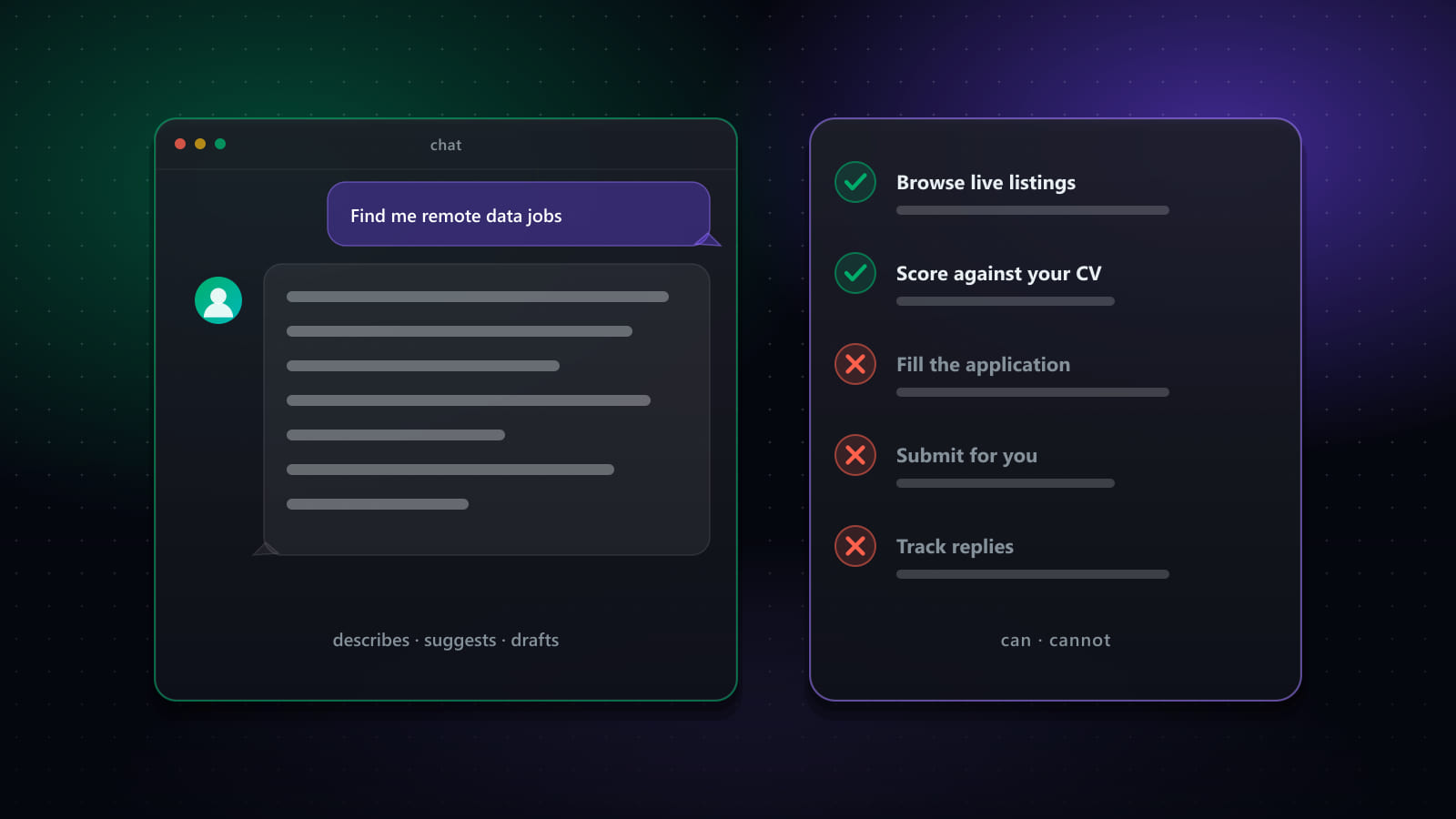
An AI job search agent is software that carries out multi-step job search tasks on your behalf rather than answering questions about them. The term is used loosely: in practice products described as agents range from form-fillers that need you present for every application, up to systems that search, score, tailor and submit unattended. The useful question is not whether a product calls itself an agent but how many consecutive steps it can take without you, and where it is required to stop.
Can an AI agent apply to jobs for me automatically?
Some can. As of September 2026, tools that will complete and submit an application without a per-application click include Best JobFinder (with a configurable review pause), LoopCV and LazyApply, with Jobright doing so partially. Tools marketed with agent language that still require you to press Submit on every application include Simplify. The distinction is worth checking before purchase, because the marketing vocabulary is nearly identical on both sides of that line.
Is it safe to let an AI agent apply to jobs for me?
It is safe in proportion to the constraints you place on it. The three that matter most are a relevance gate, so it only applies to roles that clear a match threshold; a rate limit, so its behaviour stays within human-plausible pace and volume; and a review window or audit trail, so you can see what was sent in your name. An agent running without those is not risky because it is AI — it is risky because nothing is checking its output, which is equally true of any unsupervised automation.
Will using an AI agent get my LinkedIn account restricted?
Job boards act on behavioural patterns rather than on the use of automation as such. The patterns that draw action are ones no human could produce: hundreds of applications per hour, perfectly uniform timing between actions, continuous activity without pauses, or traffic originating from a datacentre rather than your own browser session. An agent that operates at human pace through your own signed-in browser, with daily caps, looks materially different from a bulk submitter advertising four-figure daily application counts.
What can an AI job search agent not do?
It cannot create qualifications you do not have, and any output suggesting otherwise is a misrepresentation made in your name. It cannot substitute for a referral, which remains the highest-conversion route into most companies. It cannot decide what you want from your career. And it cannot compensate for poor targeting — an agent applied to a vague search produces a larger volume of poorly-matched applications, faster.
Ready to automate your job search?
Best JobFinder combines job discovery, AI skill matching, resume tailoring, and configurable auto-submit in one platform — with a 7-day free trial.
Try Best JobFinder free →