Resume Keyword Matching: How Match Scores Are Calculated
A match score looks like a measurement. It is presented as a percentage, it is precise to one decimal place, and it changes when you edit your CV. It is easy to treat it as a reading of some external fact.
It is not. A match score is the output of four design decisions a vendor made, and understanding those decisions tells you both why tools disagree and which edits will actually move the number.
Key takeaways
- A match score is computed, not measured. Four vendor decisions determine it: extraction, weighting, synonym handling, and the missing-skill penalty.
- Missing required skills usually cost more than matched ones gain — which is why adding a genuine skill you forgot to list moves the score most.
- Scores are not comparable across tools. Use them to rank postings within one tool.
- Context beats frequency in modern systems: a skill named inside a real achievement outweighs the same word in a keyword block.
- Keyword stuffing for skills you lack works exactly as designed — you pass screening, then fail the technical conversation.
The four decisions behind every score
Decision 1 — What counts as a requirement
Before anything can be matched, the system has to decide which terms in the posting are requirements. A job description contains skills, company boilerplate, benefits and legal text, and pulling the requirements out of that is already an inexact operation.
Approaches vary from a fixed vocabulary of known skills matched against the text, through statistical extraction of unusually prominent terms, to a language model asked to list requirements. Each produces a different requirement list from the same posting — and everything downstream is computed against that list.
Consequence: a tool using a fixed vocabulary cannot see a skill that is not in its vocabulary. If a posting's central requirement is a niche framework, it may simply be absent from the comparison.
Decision 2 — How much each requirement is worth
Not all requirements matter equally, so scores assign weights. Common signals: how often a term appears, whether it is in the title, whether it sits under “required” rather than “nice to have”, and how early it appears.
Some tools also let you weight skills — marking which of your own you consider core. That produces a more personally meaningful score and makes it even less comparable with another tool's.
Decision 3 — What counts as a match
The deceptively hard part. Does “Postgres” match “PostgreSQL”? Does “React” match “React Native”? Does “AWS” match “Amazon Web Services”?
Systems sit somewhere between two failure modes. Exact matching is predictable but misses real equivalences, penalising you for wording. Fuzzy matching catches synonyms but produces false positives — “React” credited for “React Native”, or “C” matching anything beginning with C. Fuzzy matching can also be order-dependent in ways that make the same input score differently on different runs.
Consequence: where you are unsure whether a tool will connect two terms, include both naturally — “PostgreSQL (Postgres)” costs nothing and removes the ambiguity.
Decision 4 — What a gap costs
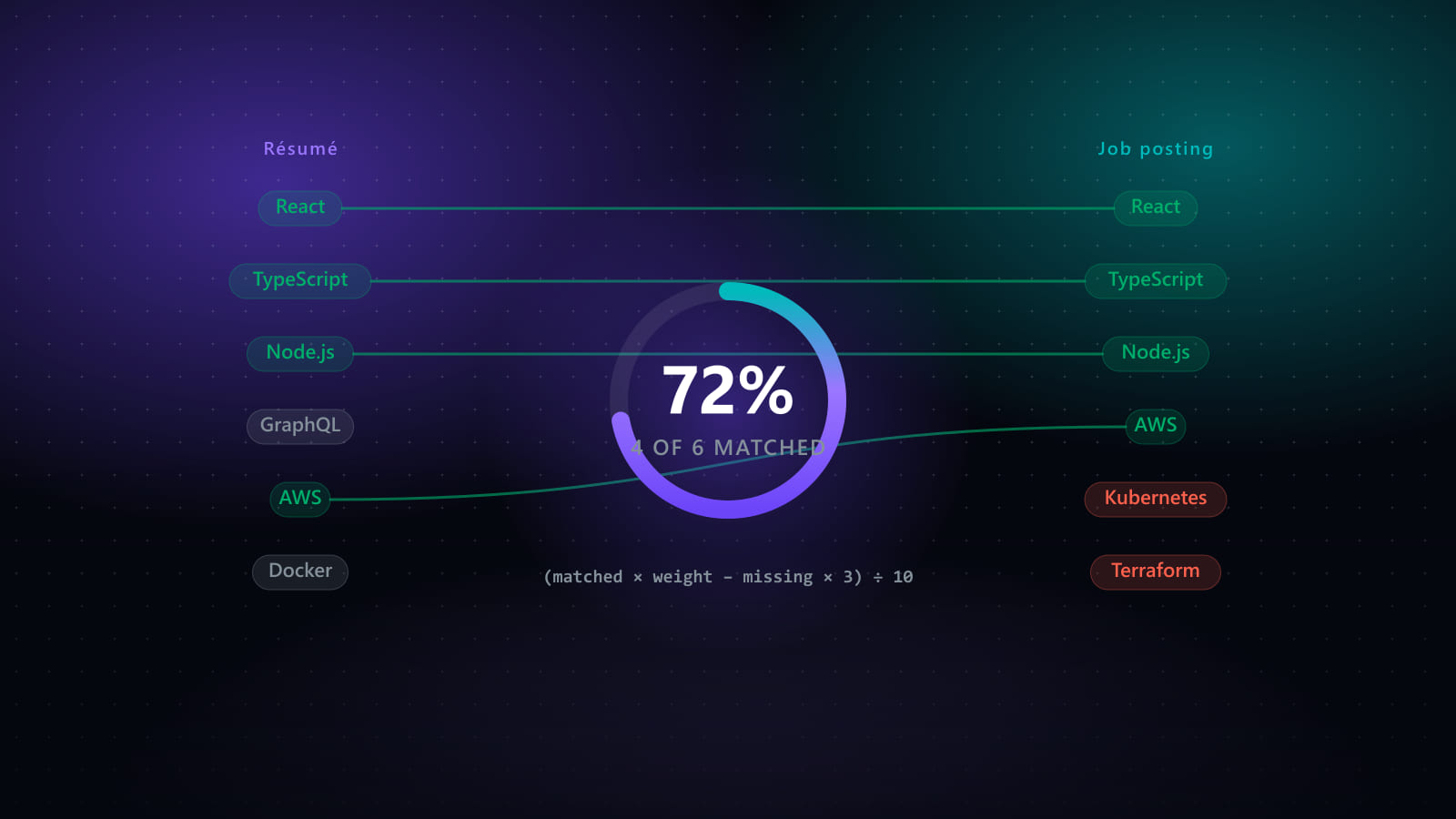
The decision that most shapes the final number. A matched skill typically contributes proportionally to its weight; a missing required skill typically incurs a flat penalty. Because the penalty is flat and the contributions are fractional, gaps dominate.
A worked illustration of the shape — exact constants vary by vendor:
score = (sum of matched skill weights − penalty × number of missing skills) / maximum possible weight
Consequence, and it is the practically useful one: the fastest way to raise a score is almost never rewording what is already there. It is finding a required skill you genuinely have and did not mention.
What this means for editing your CV
Audit for omissions first
Read the requirement list and ask, for each one, “have I actually done this?” Most people have several real skills missing from their CV simply because they were never written down. Each one added removes a gap penalty and adds a match — it moves the number twice.
Put skills inside achievements
Systems that weigh context give more credit to a skill named in a sentence describing what you built than to the same word in a list. This also happens to be what a human reader wants, so there is no trade-off to manage.
Spell out ambiguous terms once
Acronym and full form together, on first use. It costs a few characters and eliminates a whole class of matching failure.
Do not add skills you do not have
It works, which is the problem. You pass the screen, reach a technical conversation, and fail it — having spent your time and the interviewer's, and having shown the claim came from you.
How to actually use a score
- As a sorting aid. Within one tool, rank postings and spend your effort at the top of the list. This is what scores are genuinely good for.
- As a gap finder. The missing-skills list is more useful than the number, because it is specific and actionable.
- Not as a cross-tool comparison. A 72% in one product and a 68% in another say nothing about each other.
- Not as a verdict. A low score on a role you are genuinely suited to usually means the CV is describing your experience in the wrong vocabulary — which is a document problem, not a fit problem.
For what happens after matching — how screening systems rank and filter — see ATS explained, and for the practical checklist see ATS resume optimization.
Frequently asked questions
How is a resume match score calculated?
Most match scores follow the same shape: extract required skills from the job description, check which appear in the resume, weight each by how important the posting seems to treat it, apply a penalty for required skills that are missing, then normalise to a percentage. The details differ by vendor — how weights are assigned, whether synonyms are recognised, and how harshly missing skills are penalised — which is why the same resume and the same posting produce different scores in different tools.
Why do two tools give my resume different match scores?
Because a match score is not a measurement of an external fact; it is the output of design choices. Two tools can differ on which terms they extract as requirements, whether they treat 'Postgres' and 'PostgreSQL' as the same skill, how much weight a skill mentioned once carries versus one mentioned four times, and how much a missing requirement costs. Any of those differences moves the number. Use a score to rank postings against each other within one tool, not as an absolute reading.
What match score should I aim for?
Vendors commonly suggest targeting around 75–80% or higher, but the more useful interpretation is relative: within a single tool, a posting scoring 85% is a better use of your time than one scoring 45%. Chasing a specific number across tools encourages keyword stuffing, which modern screening handles poorly and which produces interviews you cannot sustain. Treat the score as a sorting aid rather than a target.
Does keyword stuffing improve a resume match score?
It can raise a naive score and tends to hurt you twice over. Systems that weigh context rather than raw frequency get little signal from a comma-separated keyword block, and some penalise text that does not read as natural language. More importantly, keywords for skills you do not have work exactly as intended — they pass screening — and then fail at the first technical conversation, which is a worse outcome than not being shortlisted.
Do missing skills matter more than matched skills?
In most scoring models, yes, disproportionately so. A missing required skill typically carries a fixed penalty while a matched skill contributes in proportion to its weight, which means a handful of gaps can outweigh a long list of matches. This is why adding one genuinely relevant missing skill you do possess but forgot to list often moves a score more than rewording several bullets you already had.
Ready to automate your job search?
Best JobFinder combines job discovery, AI skill matching, resume tailoring, and configurable auto-submit in one platform — with a 7-day free trial.
Try Best JobFinder free →