How to Tailor Your Resume for a Job in 20 Minutes
Almost everyone knows tailoring works, and almost everyone stops doing it partway through a search. The reason is not laziness — it is that most people tailor by rewriting, which takes an hour, and an hour per application is not sustainable past the first dozen.
The method below takes about twenty minutes because it is mostly selection rather than writing. It depends on one piece of preparation done once.
Key takeaways
- Build a master CV once — every real bullet you could ever use. Per-job tailoring then becomes selection, not writing.
- Extract five requirements from the posting, not twenty. Repeated, listed first, or stated as must-haves.
- Map evidence before writing anything. The gaps you find are useful information, including when they say do not apply.
- Put matching evidence in the first third of page one. That is the region that actually gets read.
- Verify titles, dates and numbers against the master before sending. This is where errors creep in.
Step 0 — Build the master CV (once, about two hours)
This is the preparation that makes everything after it fast, and skipping it is why tailoring feels expensive.
The master CV is not a document you send. It is a private, exhaustive record: every role, every project, and under each one every accomplishment you could ever plausibly want to cite — six to ten bullets per role rather than the three or four a real CV carries. Every metric you actually know. Every technology genuinely used.
Length does not matter; it might be eight pages. Its only job is to mean that when a posting asks for something, you are choosing from material you have already written rather than composing under time pressure.
Step 1 — Extract the five real requirements (5 minutes)
Job postings list fifteen to twenty things. Five of them matter. Three signals identify which:
- Repetition. Anything appearing in the summary, the responsibilities and the requirements is the actual job.
- Position. The first two or three responsibilities are usually the real ones; later entries drift into wishlist.
- Framing. “Must have” and “X years of” are hard filters. “Nice to have” and “familiarity with” are not.
Write the five down. If you cannot identify five, the posting is vague — which is itself information about the employer.
Step 2 — Map evidence (5 minutes)
For each of the five, find your strongest piece of evidence from the master CV. One line each:
Requirement: distributed systems at scale
Evidence: rebuilt the order pipeline, 40k events/min, cut p99 latency ~60%
Two things come out of this. You now know which bullets belong in the top third. And the gaps are visible — which matters, because a requirement with no evidence behind it is either something to address in a cover letter or a signal that this application is not worth making.
Three or more of five with no evidence is usually a role to skip. That decision is worth more than a well-tailored CV for a role you will not get.
Step 3 — Rewrite only what needs it (10 minutes)
Four changes, in order of value:
Reorder
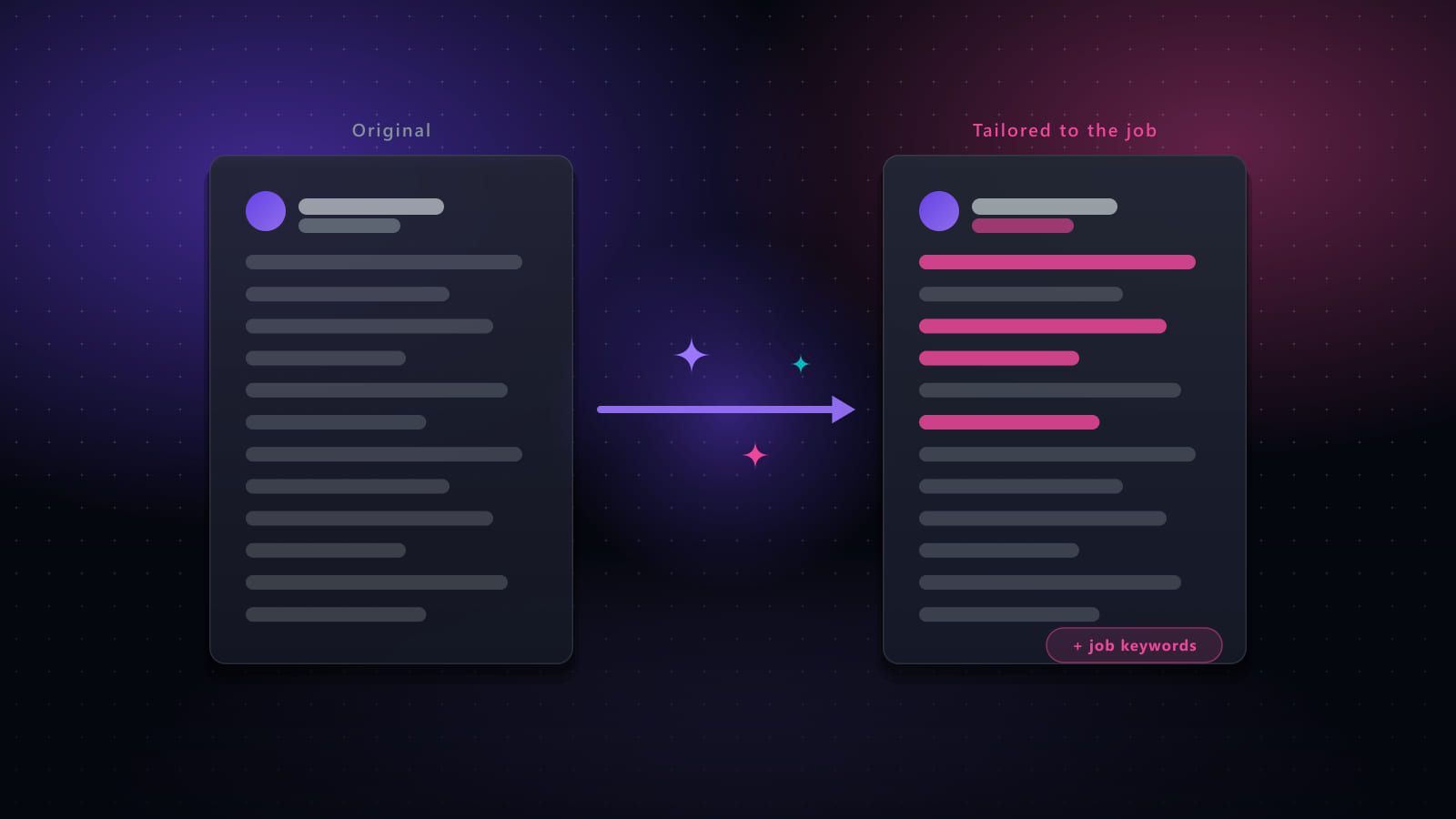
Move the mapped evidence up. Within each role, the bullets matching your five requirements go first. Across roles, if a less recent position is more relevant, consider a “Relevant experience” section ahead of the chronological list.
Adjust the summary
If you have a summary line, it should name the role you are applying for and your strongest two matching qualifications. It is the one part of a CV that should be visibly written for this posting.
Align vocabulary
Where the posting's term and yours describe the same work, use theirs. Where they do not describe the same work, do not — see what tailoring must never change.
Cut
Remove what does not serve this application. Cutting is what creates room for the relevant detail, and it is the step people skip because deleting real accomplishments feels wrong. The master CV is what makes it psychologically easy: nothing is lost, it is still there.
Step 4 — Verify (2 minutes)
Three checks before sending:
- Titles, employers and dates match the master. Errors creep in during editing, and these are the fields an employer verifies.
- Every number is real. Particularly if any part of the pass was AI-assisted.
- The first third makes the case. Read only the top of page one. Does it argue for this role?
Where automation fits
Steps 1 and 3 automate well: extracting requirements from a posting and producing a reordered draft are both mechanical. Step 2 is the one worth keeping manual — deciding which of your accomplishments best answers a requirement is judgement about your own career, and it is also where you discover that a role is not worth applying to.
Step 4 never automates, because the point of verification is that a human looked.
Grading the effort
Not every application justifies twenty minutes. A workable split:
- Priority roles — full method, manual step 2, plus a real cover letter. Two or three a week.
- Standard roles — automated reorder and vocabulary pass, then step 4 verification only. The bulk of applications.
- Speculative — master CV trimmed to two pages, no per-role work. If you would not spend five minutes on it, consider whether to apply at all.
Frequently asked questions
How do you tailor a resume for a specific job?
In four steps. First, extract the five requirements the posting actually cares about — usually the ones repeated, listed first, or stated as must-haves. Second, map evidence you already have against each one. Third, rewrite only what needs rewriting: reorder so matching evidence appears in the first third, adjust vocabulary to the posting's terms where the work is genuinely the same, and cut irrelevant content. Fourth, verify that titles, dates and numbers still match your master CV. The whole pass takes about 20 minutes once you have a master version to work from.
How long should tailoring a resume take?
About 20 minutes per application once you have a complete master CV to cut down from, and considerably longer if you are rebuilding from scratch each time. If it is taking an hour, the usual cause is that you have no master version, so every application involves rewriting rather than selecting. Building the master CV once is the single change that makes per-job tailoring sustainable.
What should you change when tailoring a resume?
Order, emphasis, vocabulary and inclusion. Put the experience matching this posting in the first third of page one, expand the relevant bullets and compress the irrelevant ones, adopt the posting's terminology where it genuinely describes work you did, and cut content that does not serve this application. What must never change: job titles, employment dates, employer names, qualifications, and any quantified result.
Should you use the exact keywords from the job description?
Use them where they honestly describe work you have done, and place them inside real achievements rather than in a keyword list. Screening systems increasingly weigh context rather than raw term frequency, so a skill named inside a sentence describing what you built counts for more than the same word in a comma-separated block at the bottom. Never include a term for a technology you have not used — it survives screening and then fails at the first technical question.
Ready to automate your job search?
Best JobFinder combines job discovery, AI skill matching, resume tailoring, and configurable auto-submit in one platform — with a 7-day free trial.
Try Best JobFinder free →