The Screening Questions That Silently Reject You, and How to Answer the Rest
Written by Best JobFinder’s founder.
"Years of professional experience with Python: ___"
You have written Python for nine years: five professionally, four before that as a student and on side projects. Which number goes in the box? Put 9 and you are overstating what the question asked; it will come up in the interview, and it should. Put 5 and a filter set at "6+" removes you from a role you could do. Neither answer is wrong. The point is that the box is not a question about you. It is a filter, configured by a person, and you should answer it knowing that.
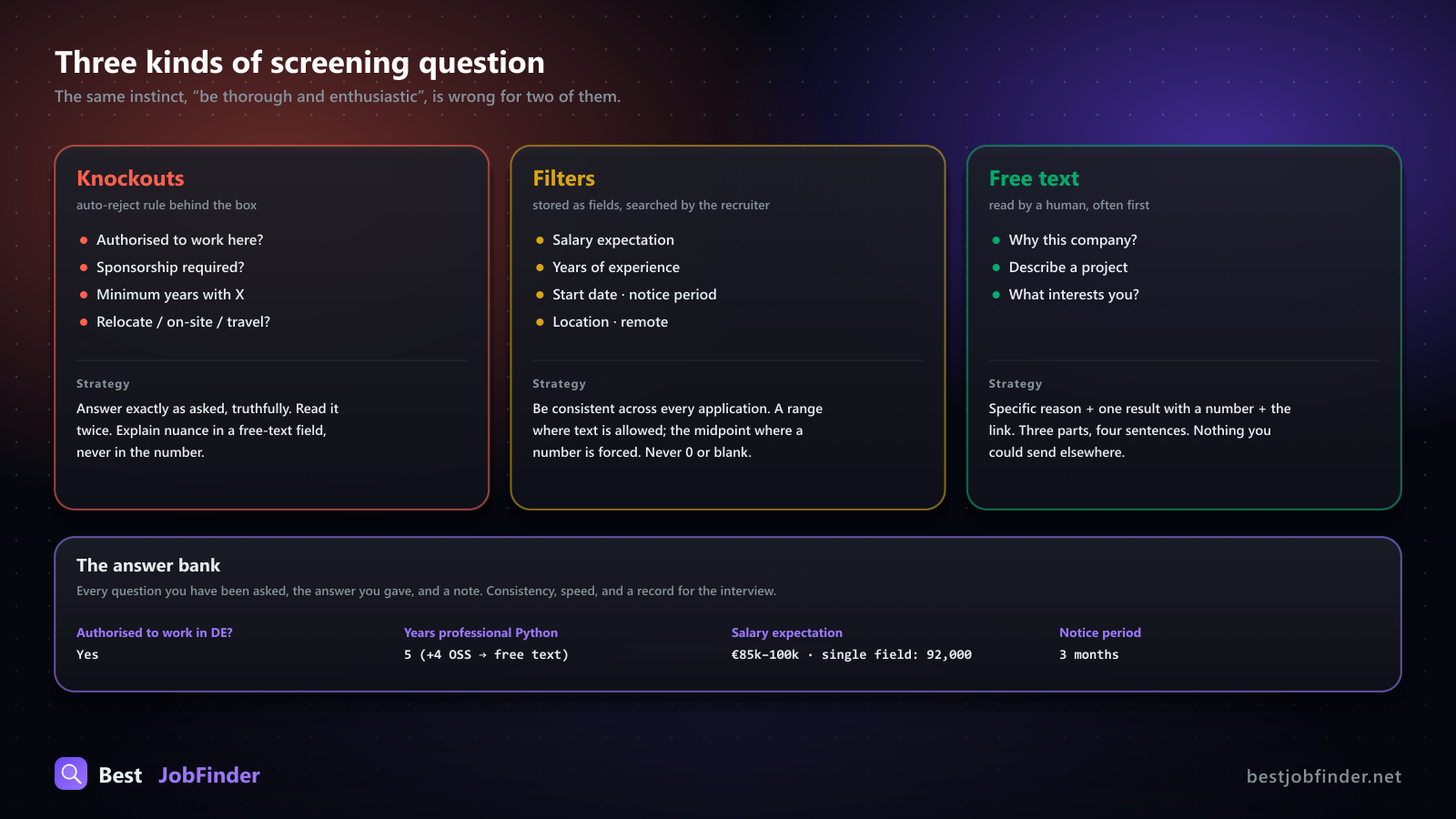
Application forms ask three kinds of questions, and the same instinct ("be thorough and enthusiastic") is wrong for two of them.
Kind 1: knockouts
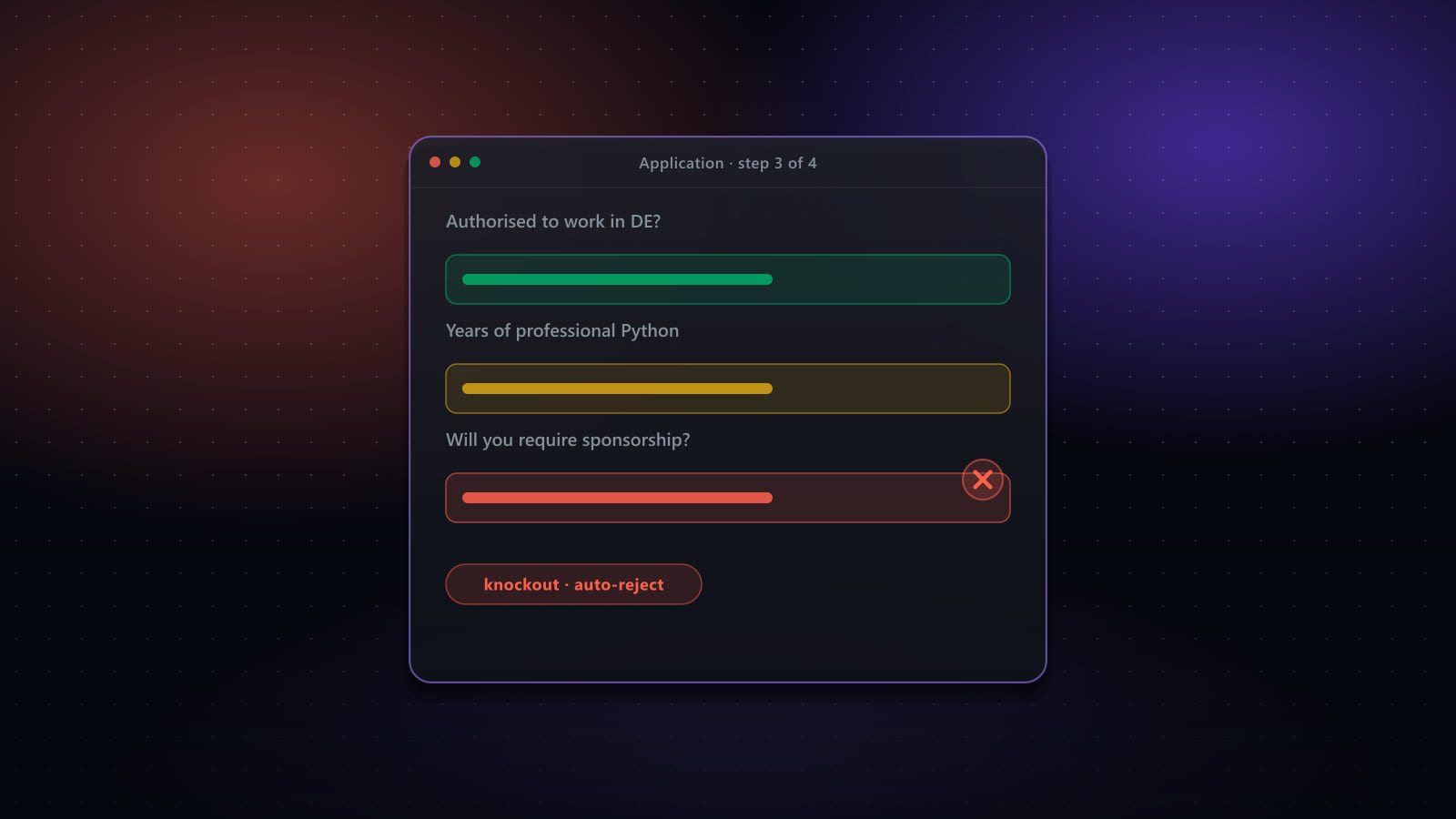
A knockout is a question with an auto-reject rule behind it. The recruiter set it up once; the system applies it to everyone. You cannot see which questions are knockouts, but they are almost always from this list:
- Legally authorised to work in this country?
- Will you now or in the future require sponsorship?
- Willing to relocate to / work from [city]?
- Willing to work [shift / on-site / travel percentage]?
- Minimum years with a named technology
- A required certification or degree
- Minimum salary expectation above the band
Answer them exactly as asked, and truthfully. There is no strategy for a knockout other than reading the question twice. "Years of professional experience with X" is not "years since you first used X". "Authorised to work" is not "willing to work". If the honest answer rejects you, the role was closed to you before you applied, and you have saved yourself a month of silence.
The one thing to do deliberately: when the honest answer is borderline, answer the form's question and explain the nuance in a free-text field if one exists. "4 years professional, 3 more in open-source maintenance of X" is a sentence a recruiter can act on. A box cannot hold it.
Kind 2: filters
These do not reject you. They are stored as structured fields and used to search the pool: location, years of experience, salary expectation, start date, seniority, languages. Answer them consistently, because inconsistency is what gets noticed.
Salary expectation
The most mishandled field on any form. Some rules:
- Do your market research first, from sources that publish ranges rather than averages: Levels.fyi for tech companies, the posting itself (many jurisdictions now require a range), and recent postings for the same title at similar companies.
- If the form allows text, give a range, with the lower end at the number you would actually accept. "€85,000 to €100,000 depending on the total package" is a filterable answer that keeps the conversation open.
- If the form forces a single number, give the midpoint of your range, not the floor. A single number is read as "this is what they want", and nobody negotiates you up from the floor.
- Never leave it blank or write 0 to dodge it. A zero is a filter miss, and "negotiable" in a numeric field is a parse error.
Years of experience
Count professional years with the thing, as a whole number, and keep the same number on every application that month. Recruiters cross-check between your form answers, your resume dates and your LinkedIn. A mismatch costs more than a conservative number.
Start date and notice period
Give the real one. "Immediately" when you have a three-month notice period wastes a recruiter's scheduling and will surface at offer stage.
Location and remote
If the posting says remote and the form asks for a city, give the city you will actually work from. Tax and employment law make this a knockout at some companies even when the role is remote.
Kind 3: free text
"Why do you want to work here?" "Describe a project you are proud of." "What interests you about this role?" These are not filtered. They are usually the first thing a human reads, before the resume, because they are short and sit at the top of the candidate record.
Three parts, two or three sentences each:
- A specific reason for this company or role. Something that could not be pasted into another application: their product, a technical decision, a problem the posting names.
- One concrete result from your experience that relates to it, with a number.
- The link. How the result bears on what they need.
Your posting mentions moving the ingestion pipeline to per-tenant databases next year. I did that migration at my current company for a payments service handling ~2,000 req/s, with zero downtime, and the part I would most want to talk about is how we kept the rollback path open for six weeks. That is the problem I want to work on next.
Four sentences. Compare it with the usual "I am passionate about your mission and believe my skills would be a great asset to your dynamic team", which could be sent anywhere and says nothing.
The answer bank
The reason screening questions get careless answers is that they come at the end of a twenty-minute form, and you are answering them for the thirtieth time. The fix is to stop composing them.
Keep one file (a spreadsheet, a note, a Markdown table) with every question you have been asked and the answer you gave:
| Question | Answer | Notes |
|---|---|---|
| Authorised to work in DE? | Yes | EU citizen |
| Sponsorship required? | No | |
| Years professional Python | 5 | +4 OSS; mention in free text |
| Salary expectation | €85k–100k | single-number forms: 92,000 |
| Notice period | 3 months | negotiable to 2 |
| Why this company (template) | [3-part structure] | rewrite para 1 per company |
Three things it buys you. Consistency across applications, which is what recruiters notice. Speed, so the questions get the attention they deserve instead of the attention that is left. And a record: when an interviewer asks "you said five years of Python?", you know exactly what you said and where.
Mark the sensitive rows (salary, visa status, health, reasons for leaving) so you never paste them somewhere they were not asked for.
Questions that are not questions
- Voluntary self-identification (gender, ethnicity, veteran status, disability). In most systems these are collected separately for compliance reporting and are not shown to the hiring manager with your application. Answering is your choice; "decline to answer" is a normal option, not a red flag.
- "Mark this job as a top choice" (LinkedIn). This is a signal to the employer, not a question. Use it on the handful of roles where it is true. Ticking it on every application makes it mean nothing, and on some forms it is pre-checked, so look.
- "How did you hear about us?" A referral source here is read. If someone referred you, name them exactly as they appear in the company.
- Consent checkboxes. Data-retention consent (keep my application for future roles) is harmless. Marketing consent is unrelated to the job. Read which is which.
Before you press Submit
- Every numeric field has a number in it, not a zero, a dash or "see resume".
- Every answer matches the resume you attached and the number in your answer bank.
- No free-text answer contains a sentence you could send to another company.
- No free-text answer contains "As an AI language model", a stray
{"{"}"answer": …}, or a paragraph that restarts mid-sentence. If you draft with AI, read the paste. - The cover letter field, if present, has either a specific letter or nothing. Not a generic one.
The form is the last thing standing between your resume and a human. It is also the part most people do fastest. Reverse that.
I build a job-search tool for a living; it keeps an answer bank like the one above and fills these forms from it. The bank works just as well as a spreadsheet, and I would start there.
Ready to automate your job search?
Best JobFinder combines job discovery, AI skill matching, resume tailoring, and configurable auto-submit in one platform — with a 7-day free trial.
Try Best JobFinder free →