Auto-Fill, Not Auto-Reject: Why Fast Applications Still Need to Be Accurate
Twenty-five minutes typing an application by hand and two minutes of careless autofill can land in the exact same place: rejected, for reasons that have nothing to do with whether you're qualified. A dropdown left on its placeholder text, a checkbox that shouldn't have been checked, an answer copied from a different job that no longer applies — none of these show up as an error message. They just quietly cost you the interview.
Key takeaways
- Speed and accuracy in autofill are separate problems — going faster shouldn't require giving up correctness checks.
- A dropdown left on placeholder text like 'Select an option' is not the same as a real answer, and autofill needs to recognize the difference explicitly.
- A pre-checked box on the page itself has to be actively noticed and corrected, not just left alone because automation only skips fields it can't answer.
- Stale or mismatched answers copied from a previous job are a quieter failure mode than a blank field — nothing flags them as wrong.
- Raw JSON, code fences or unprocessed AI output must never reach an actual form field — only clean, human-readable text belongs there.
The specific ways fast autofill goes wrong
- Placeholder values treated as answers. A "Select an option" dropdown that autofill skips because it looks already-filled, when nothing has actually been chosen.
- Boxes that check themselves. Some boards pre-check certain boxes by default on page load — leaving every field autofill doesn't understand untouched means those stay checked too, silently.
- Answers that don't match this job. An answer correctly given for a different application, reused without adjustment where it no longer fits.
- Raw output leaking into the form. A generation step that isn't fully cleaned up can paste a JSON fragment or a code block straight into a text field — unmistakably careless to whoever reads it.
Why each of these needs a specific fix, not a general one
"Be more careful" isn't an engineering answer to any of these. A placeholder needs to be explicitly recognized and treated as an empty field before any value is trusted. A pre-checked box that shouldn't be checked needs to be actively detected and unchecked, not passively left alone. Any answer written into a field should pass through a check that catches JSON-shaped or otherwise malformed text before it's typed in, and returns it to a normal missing-field state instead.
What this means for how much you should trust an auto-apply run
None of this means autofill is inherently risky — it means the accuracy work is exactly as important as the speed work, and it's fair to ask how a tool handles these specific cases before trusting it with an application that matters. Pair that scrutiny with configurable thresholds for what submits automatically so a mistake, if one slips through, gets caught in review rather than sent.
Frequently asked questions
How does an autofill tool actually cause a rejection?
A handful of specific ways: a dropdown left on a placeholder value like 'Select an option' instead of a real answer, a required checkbox that got checked or unchecked incorrectly, a stale answer copied from a different job that no longer applies, or a raw JSON fragment pasted into a text field because a generation step wasn't cleaned up before it reached the form.
Is a placeholder value in a dropdown actually different from a real answer?
Yes, and treating them as equivalent is a common bug — 'Select an option' visually sits in the field the same way a real selection would, but it means nothing was actually answered. Any autofill logic has to recognize placeholder text specifically and treat it as unanswered, not as an already-filled field to skip.
Why would a checkbox get checked when it shouldn't be?
Some job boards render a 'mark this as one of my top choices' style checkbox pre-checked by default on the page itself. If autofill only skips fields it doesn't know how to answer, a pre-checked box like that stays checked by omission — automation has to actively notice and uncheck it, not just leave every field it didn't touch alone.
Does faster autofill inherently mean lower quality?
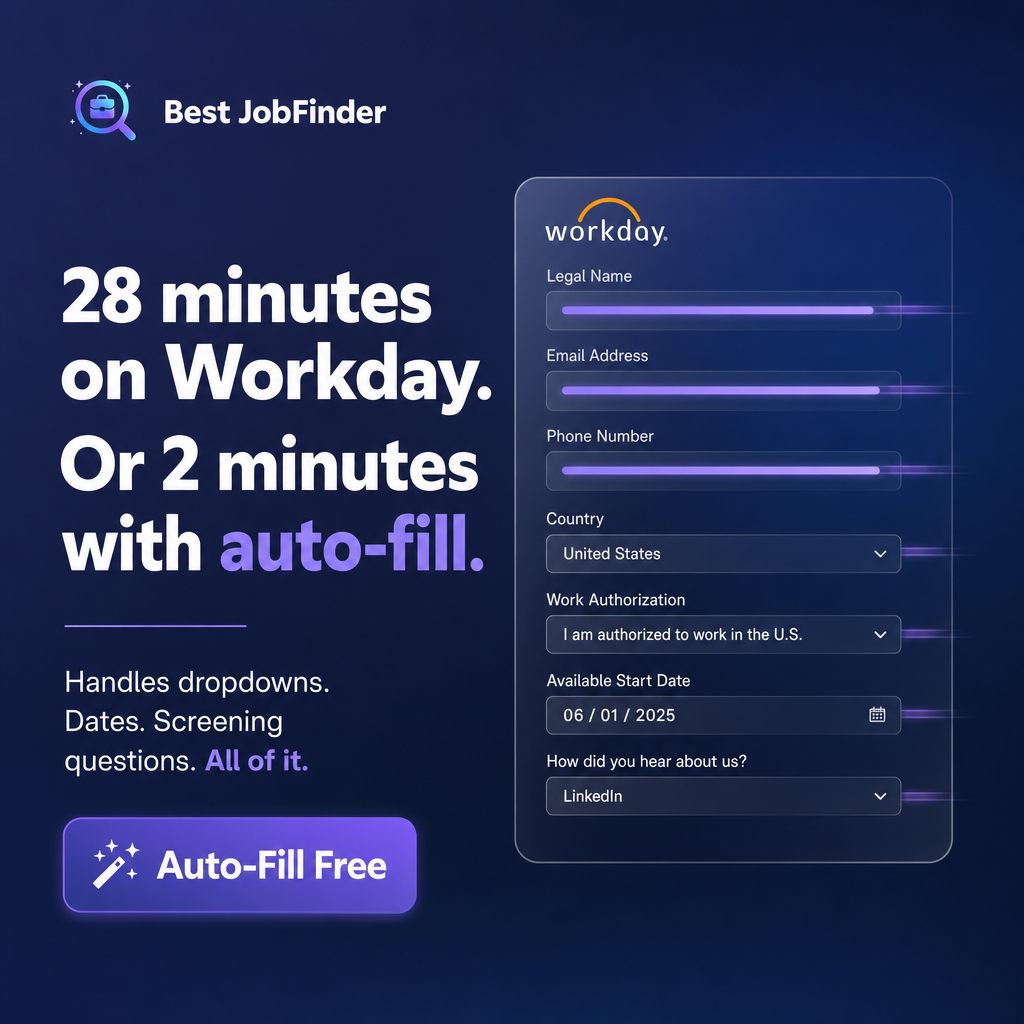
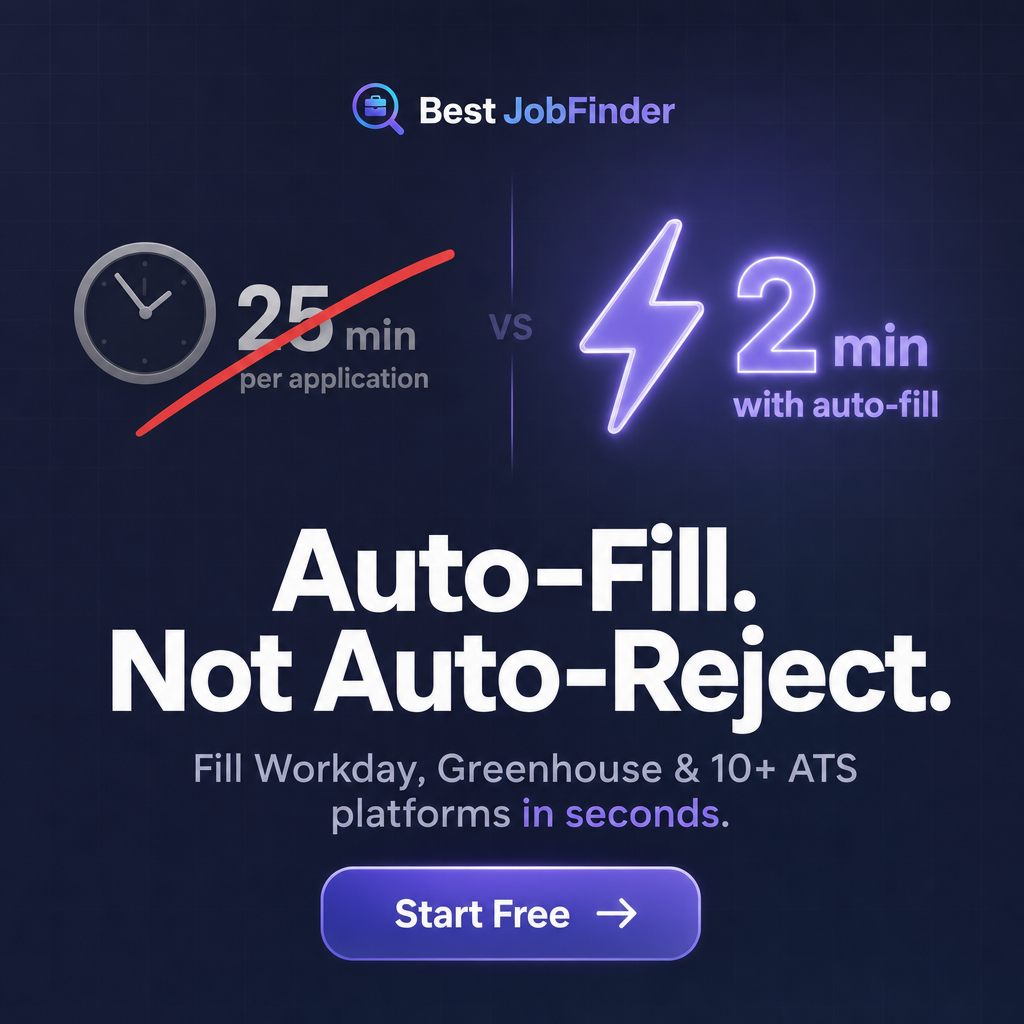
No — the speed and the accuracy are separate engineering problems, and solving the first one doesn't require giving up the second. The two minutes versus twenty-five minutes difference comes from not re-typing the same information by hand, not from skipping the checks that keep the typed information correct.
Ready to automate your job search?
Best JobFinder combines job discovery, AI skill matching, resume tailoring, and configurable auto-submit in one platform — with a 7-day free trial.
Try Best JobFinder free →