Interview Prep: Technical Rounds vs. HR Rounds — How to Practice Both
Most candidates prepare for "the interview" as if it's one thing. It isn't. A technical round and an HR/behavioral round test completely different capabilities, and preparing for one does almost nothing for the other.
What a Technical Round Actually Tests
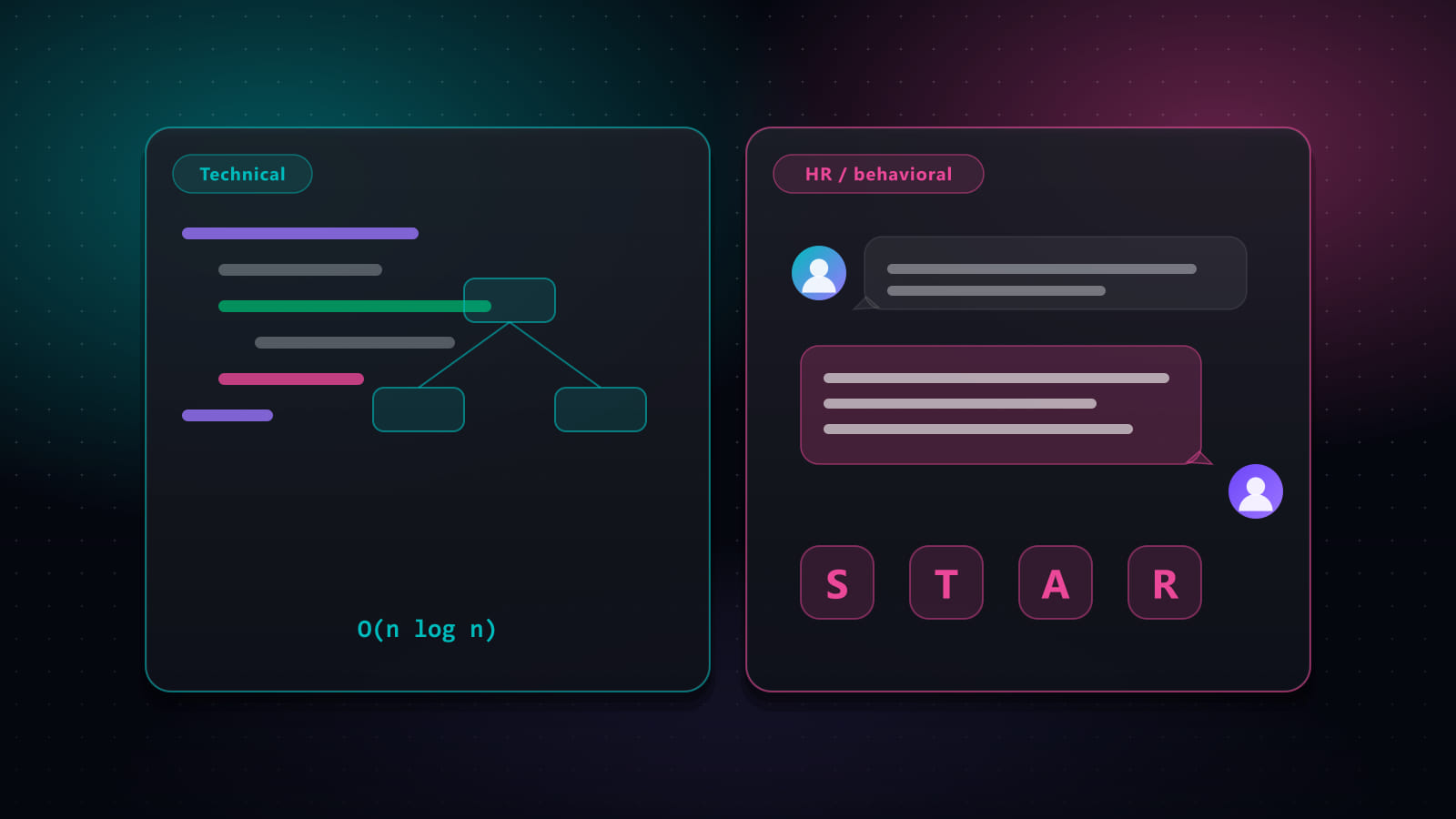
Technical rounds — whiteboard problems, system design, take-home exercises, live coding — are testing whether you can do the job: your depth in the required tools and concepts, how you reason through an unfamiliar problem, and whether you can explain your thinking out loud while you work.
Preparing for this well means practicing under realistic conditions: timed, without your usual references, and explaining your reasoning as you go — not just solving problems silently at your own pace.
What an HR/Behavioral Round Actually Tests
HR and behavioral rounds test something almost entirely different: can you explain and market your own background clearly, how you handle pressure and conflict, whether your motivations line up with the role, and — bluntly — whether you're someone the team wants to work with every day.
This is the round candidates most often under-prepare for, because it feels less "objective" than a coding problem. It isn't less important — it's just measured differently, usually through open-ended questions with no single correct answer.
Why "Interview Readiness" Needs Its Own Practice
Being technically strong and being interview-ready are not the same thing. A candidate can be fully capable of the job and still give vague, rambling answers to "tell me about a time you disagreed with a manager" — not because they lack the experience, but because they've never practiced structuring it into a clear answer.
This is exactly what Best JobFinder's Career Coach targets with its dedicated Interview Questions set — open-ended practice specifically aimed at how well you explain and market your background, how you come across under the kind of pressure-testing questions HR actually asks, and, where relevant to your target role, how ready you look for management and stakeholder conversations. Each attempt is AI-graded and comes back with a report showing your strongest answers and concrete suggestions for the ones that needed more structure.
Job-Based Mock Exams: Practice That Matches the Real Thing
Generic interview-question banks are better than nothing, but they're not targeted — a list of "top 50 interview questions" isn't built around your specific role or market. A job-based preparation exam is: questions generated from your actual target role, mixing technical assessment with the HR-facing readiness check above, so practicing against it looks a lot more like the real screening you're about to face.
A Simple Two-Track Prep Routine
- Technical track: timed practice problems in your actual stack, reviewed for correctness AND clarity of explanation — not just "did I get the right answer."
- HR/readiness track: open-ended questions about your background and motivations, answered out loud or in writing, then reviewed for structure — does the answer have a clear point, not just a story with no conclusion.
Run both tracks in the same week rather than sequentially — an interview loop rarely separates them cleanly, and neither should your prep.
Related: How to get the most out of the Career Coach module → · AI resume and cover letter templates → · How to build a career roadmap that actually gets you promoted →
Ready to automate your job search?
Best JobFinder combines job discovery, AI skill matching, resume tailoring, and configurable auto-submit in one platform — with a 7-day free trial.
Try Best JobFinder free →