Cover Letters: When to Write One, When to Skip It, and a Four-Paragraph Structure That Is Not Generic
Written by Best JobFinder’s founder.
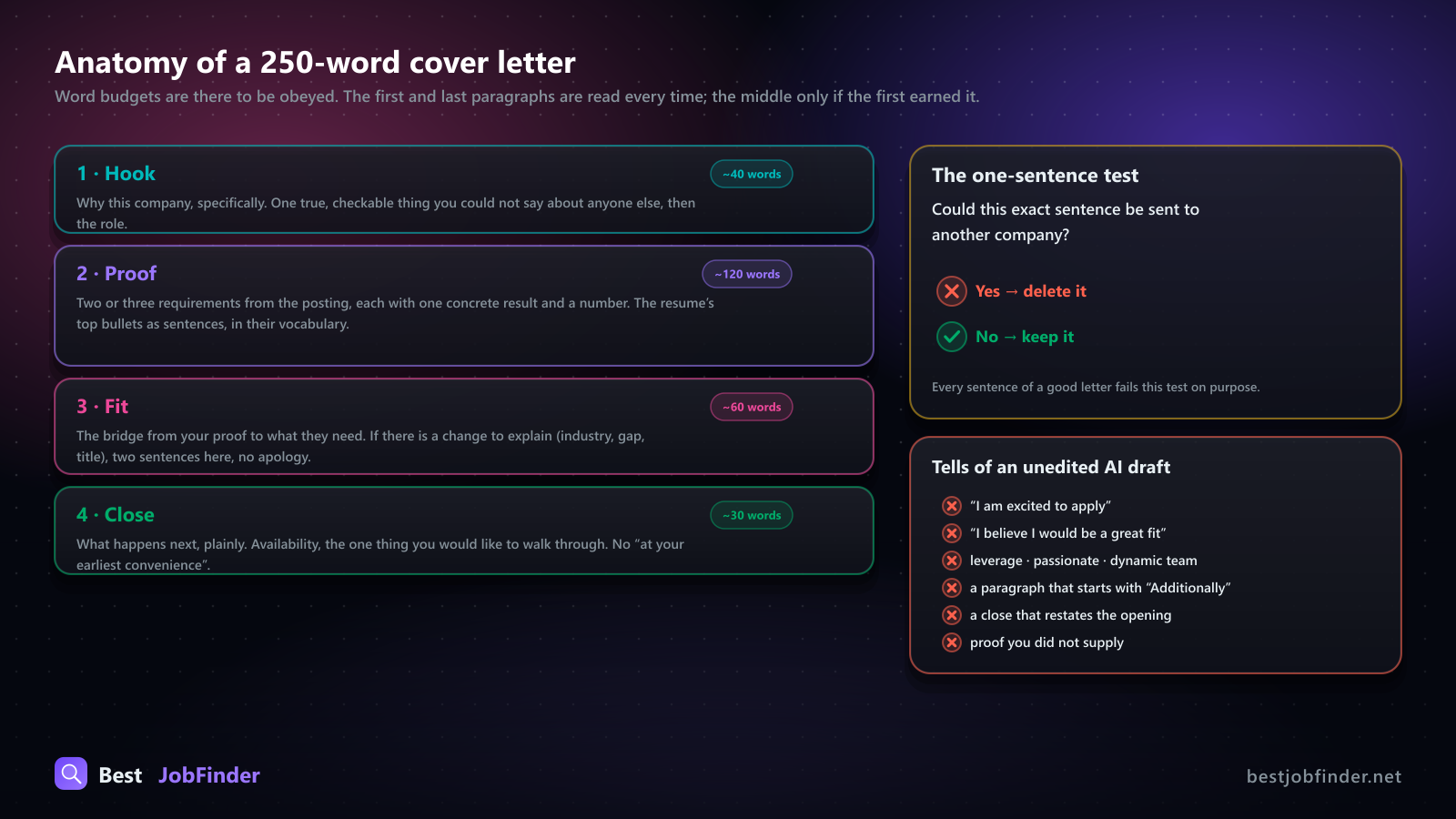
Here is the whole test. Take any sentence from your cover letter and ask: could I send this exact sentence to another company? If the answer is yes for every sentence, the letter is doing nothing, and a recruiter who has seen four hundred of them will know in the first line.
"I am excited to apply for the Senior Backend Engineer position at Acme. With over eight years of experience building scalable systems, I believe I would be a great fit for your team." Both sentences pass the test. Both could go to anyone. Delete them.
This post is about the letters that fail the test on purpose: when they are worth writing, how to structure one in 250 words, and how to use an AI draft without ending up with the paragraph above.
When a cover letter changes the outcome
- The form requires it. Obviously. But also: when it is an optional free-text field on a Lever or Greenhouse form, a short specific one is read, because it sits right next to the resume on the recruiter's screen. (Lever's "Additional information" box is where it goes; Greenhouse has an optional upload or "enter manually" field.)
- You are changing something. Career change, industry change, a gap, relocation, a step down in title on purpose. The resume cannot explain a change; a letter can, in two sentences.
- The company is small. At a fifteen-person startup the founder reads applications. They want to know you chose them, not a job title.
- You have a referral or a specific connection. "Dana on your platform team suggested I apply after we worked on the X migration together" is the strongest first sentence available to you, and it only exists in a letter.
- The posting asks a question. Some do: "Tell us about a system you are proud of." That is a cover letter prompt with the generic parts removed. Answer it and nothing else.
When to skip it
- It is optional, the company is large, and you have nothing specific to say. A generic letter is a worse signal than none. It tells the reader you had the time to write and chose to say nothing.
- You are applying at volume to similar roles. Your effort goes into the resume's first screen, which is read every time, rather than a letter that is read sometimes.
- The application is LinkedIn Easy Apply or similar with no letter field. Do not paste one into a "message to the hiring team" box unless the box asks for it.
The structure: four paragraphs, 250 words
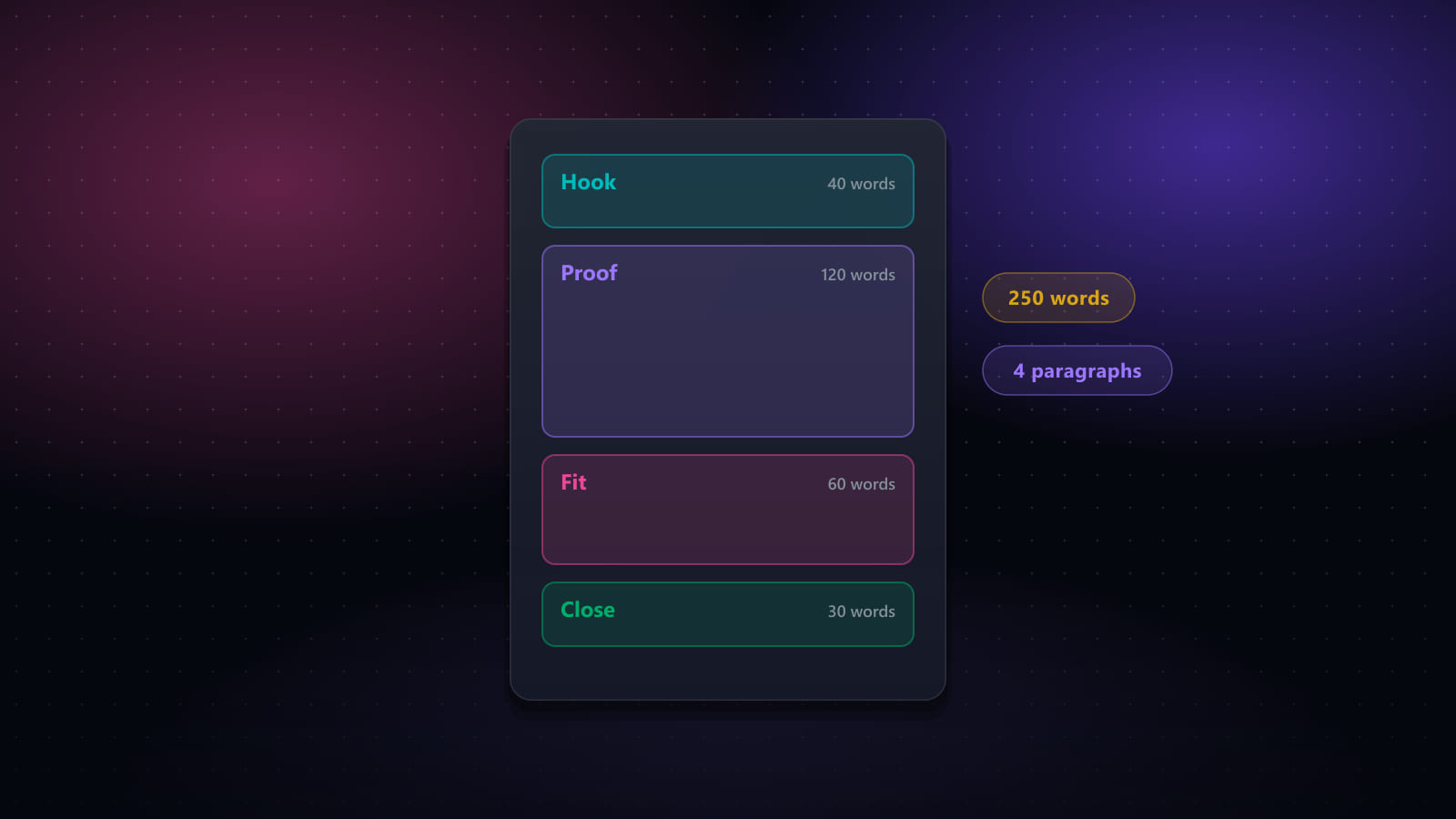
Word budgets are there to be obeyed. A recruiter reads the first paragraph and the last; a hiring manager reads the middle only if the first earned it.
1. Hook (about 40 words): why this company, specifically
One thing about them that you could not say about anyone else, and it has to be true and checkable. Their product, a technical decision they wrote about, a problem their job posting names, a person you know there. Then the role.
Your engineering blog post on moving the ingestion pipeline off Kafka to a custom log is the most honest write-up of that trade-off I have read, and it describes the kind of problem I want to work on. I am applying for the Senior Backend Engineer role on that team.
2. Proof (about 120 words): two or three requirements, with evidence
Pick the two or three requirements from the posting you most clearly meet, and give one concrete result for each. Numbers where they exist. This paragraph is the resume's top bullets, rewritten as sentences, in the posting's vocabulary.
At my current company I own the Go service that handles payment events at around 2,000 requests per second. Over the last year I cut its p99 latency from 840 ms to 210 ms by batching writes and adding per-route tracing, and I led the migration from a shared Postgres to per-tenant databases without downtime. I also ran the on-call rotation for that service and brought weekly pages from 14 to 3, mostly by fixing the alerts rather than the code.
3. Fit (about 60 words): the bridge
Connect the proof to what they need. If there is a change to explain (industry, gap, title), this is where, in two sentences, with no apology.
The posting mentions moving to multi-region writes next year. That is the same class of problem as the tenant migration above, and it is the reason this role rather than another backend role.
4. Close (about 30 words): the ask
What happens next, stated plainly. No "I look forward to hearing from you at your earliest convenience."
I would be glad to walk through the latency work in detail. My CV is attached; I am available to start in four weeks.
That is 250 words. Every sentence fails the generic test, which is the goal.
Using AI without sounding like it
A language model is good at the shape of a cover letter and bad at the content, because the content is specifics it does not have. So give it the specifics and take the shape.
- Feed it the inputs, not the task. Paste the posting, your three chosen proof bullets with numbers, and the one specific thing about the company. Ask for a 250-word letter in the four-paragraph structure. Do not ask it to "write a cover letter for a backend role at Acme"; it will invent the proof.
- Delete anything it added that you did not supply. If it says you are "passionate about distributed systems" and you did not say that, it is filler. If it says you "led a team of twelve" and you did not, it is a lie you are about to sign.
- Run the generic test on its output. Models default to sentences that could go to anyone. Expect to rewrite the hook and the close by hand every time.
- Watch for the tells. "I am excited to apply", "I believe I would be a great fit", "leverage", "passionate", "dynamic team", a closing sentence that restates the opening, and any paragraph that starts with "Additionally". A reader who has seen a thousand AI drafts recognises all of them.
- Read it aloud. If a sentence is one you would not say to the hiring manager across a table, change it.
Small things that get letters binned
- A letter addressed to the wrong company. It happens more than you would think, and it ends the application.
- More than one page. Nobody reads page two of a cover letter.
- Restating the resume in prose. The letter's job is to say what the resume cannot: why them, what the numbers mean, what changed.
- Salary, notice period, or availability details that the form already asked for. Answer those in the form.
- Attaching it as a
.pagesfile or a Google Docs link. PDF, same filename convention as the CV.
The one-sentence version
If you remember nothing else: every sentence should be one that only you could write and only to them. Four paragraphs, 250 words, numbers in the middle, a real reason at the top, a plain ask at the bottom. When you cannot write that letter, do not write one.
I build a job-search tool for a living. The four-paragraph structure above is what its cover-letter drafts follow; you can apply it with nothing but a blank page.
Ready to automate your job search?
Best JobFinder combines job discovery, AI skill matching, resume tailoring, and configurable auto-submit in one platform — with a 7-day free trial.
Try Best JobFinder free →Related Articles
 How-To Guides
AI-Generated Cover Letters: Why "Personalized" Has to Mean Per-Job
6 min read
 Resume Tips
AI Resume & Cover Letter Templates: How Tailored Applications Get You More Interviews
7 min read
 Resume Tips
One Click, Three Documents: Generating a Matched CV, Resume, and Cover Letter Together
6 min read