AI-Generated Cover Letters: Why "Personalized" Has to Mean Per-Job
"Dear Hiring Manager, I am writing to express my interest in the [Job Title] position at [Company]" is not a personalized cover letter, no matter how carefully the rest of it is written — it's a template with two blanks. A hiring manager reading fifty of these in a row notices the pattern immediately, and it works against you exactly when a cover letter was supposed to be the place you stood out.
Key takeaways
- A cover letter with only the job title and company name changed is a template, whether or not it was AI-generated.
- Genuine personalization draws on the specific posting's stated priorities and your own background — not a generic structure with blanks filled in.
- A cover letter is most valuable where a resume alone can't explain something: a career change, a gap, or a specific reason for wanting this company.
- Not every application needs a full cover letter — reserve real effort for roles you actually want.
- The generation step should produce plain, readable text — never a JSON fragment or raw AI scaffolding pasted into the letter.
What "unique for every application" actually requires
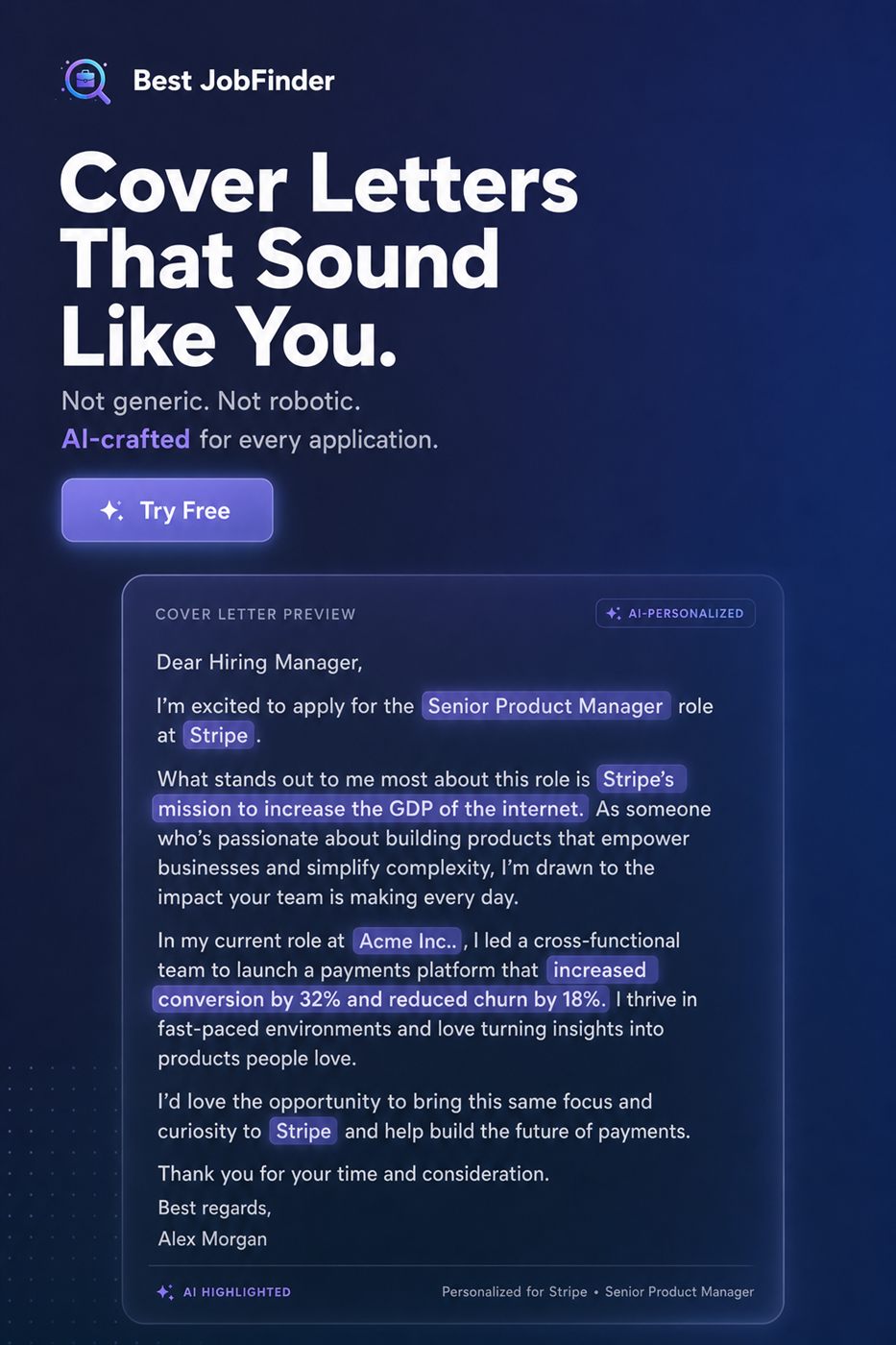
Generating a letter that's genuinely specific to a job means reading the posting closely enough to identify what it's actually emphasizing — not just its title, but which two or three qualifications it repeats or lists first — and then connecting those specifically to real parts of your own background. A letter built this way changes meaningfully from job to job, because the input it's built from changes.
The failure mode worth watching for
AI-generated text can slip into exactly the same generic phrasing a bad template produces if it isn't actually grounded in the job description and your profile — "I am a driven professional with a passion for excellence" tells a hiring manager nothing, AI-written or not. The letter should reference something a generic version couldn't: the specific role's priorities, a specific accomplishment of yours that answers them.
Full CV or tailored — the same choice applies to cover letters
Just like resume generation, a cover letter pass can run in a comprehensive mode that draws on your entire background, or a tailored mode that ruthlessly narrows to what's relevant to this specific job. For a cover letter, tailored is almost always the right default — a letter's entire purpose is focus, not completeness.
Where it fits with the rest of the application
A cover letter generated in isolation from your resume risks repeating the same two bullet points, or contradicting a detail the resume states differently. Generating both from the same job description in one pass — see one click, three documents — is what keeps them consistent with each other instead of independently "personalized" in ways that don't quite agree.
Frequently asked questions
Can a hiring manager tell when a cover letter is templated?
Often, yes — a letter that could be sent to any company in your field, with only the name swapped in, tends to read as generic even when it's well-written. The tell isn't AI versus human writing, it's whether the content references anything specific to that job and that company, or could apply anywhere.
What makes an AI-generated cover letter actually personalized rather than templated?
It has to draw on the specific job description — the role's stated priorities, the language it uses — and on your own actual background, not a generic paragraph structure with blanks filled in. A letter is personalized when it would need to be substantially rewritten to send to a different job, not just re-titled.
Does a cover letter still matter if I'm applying with a strong tailored resume?
In many cases yes, especially when a resume alone can't explain something — a career change, a gap, or why you specifically want this company rather than any company in the field. A resume shows what you've done; a cover letter is the one place to say why this role, in your own framing.
Should every application include a full cover letter?
Not necessarily — some postings don't request one, and for high-volume, lower-priority applications, the time may be better spent elsewhere. Reserve a genuinely personalized cover letter for roles you actually want, and let a tailored resume alone carry the rest.
Ready to automate your job search?
Best JobFinder combines job discovery, AI skill matching, resume tailoring, and configurable auto-submit in one platform — with a 7-day free trial.
Try Best JobFinder free →